Hello Toys: A Font That Captures Joyful, Playful Branding
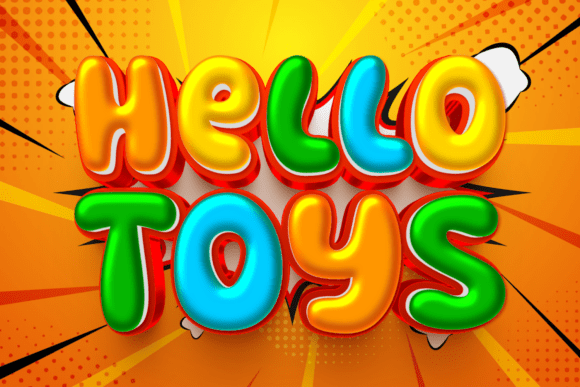
There are moments when a design project demands more than just clean text; it requires an immediate burst of energy. You know the feeling—you’re working on a flyer for a local fair, a logo for a new bakery, or a cover for a children’s activity book, and standard fonts just fall flat. They lack the necessary spark to grab attention instantly. This is exactly where specialized display typography steps in, transforming ordinary text into a visual statement. The "Hello Toys" typeface is a perfect example of this transformation. It isn't just a set of characters; it is a vibrant, cartoon-inspired font bursting with life. With its chunky, balloon-like letterforms filled with bright, glossy shades, it creates a fun 3D effect that feels tactile and almost candy-like. For anyone working in branding, packaging, or creative marketing, understanding how to leverage a font like this can be the difference between a design that blends in and one that truly pops off the page.
The Psychology of "Chunky" Typography
Why do certain fonts make us feel happy or nostalgic? It often comes down to shape language. Sharp angles and thin serifs can suggest seriousness, luxury, or corporate efficiency. In contrast, the visual characteristics of Hello Toys rely on rounded edges and thick strokes. These elements mimic the aesthetics of playfulness and safety—think of soft pillows, balloons, or bouncy balls. When you use a typeface with bold outlines and rich gradients, you are sending an immediate psychological signal to your audience that your content is approachable, fun, and youthful.
This makes it a prime asset for specific sectors. If you are a small business owner running a daycare, a pediatric dentist office, or a toy store, your visual communication needs to lower the barrier to entry. You want parents and children to feel welcomed the moment they see your signage or website. By utilizing a creative font that mimics the texture of inflated objects, you are visually reinforcing a message of joy and dynamism. It moves beyond simple readability to create an emotional connection, which is a cornerstone of effective brand identity.
Practical Applications: Beyond the Toy Store
While the name "Hello Toys" suggests a specific niche, the utility of a high-quality display font extends far beyond toy packaging. As a designer or entrepreneur, recognizing the versatility of such a bold typeface allows you to use it as a secret weapon across various mediums. Because it is a premium font designed for impact, it works best in scenarios where you need to capture attention quickly—think headlines, logos, and call-to-action graphics rather than long-form body text.
Consider the world of food branding. A chunky, glossy font is perfect for a candy shop, a donut brand, or a smoothie bar. The letterforms naturally evoke the roundness and sweetness of food items. In the realm of event planning, this style is ideal for birthday invitations, baby shower graphics, or festival posters. It immediately sets the tone for a celebration. Even in digital spaces, such as YouTube thumbnails or Instagram stories, using a bold, 3D-effect font can significantly increase click-through rates. It breaks the monotony of the feed, offering a tactile appearance that makes the viewer want to reach out and touch the screen.
Matching Typography to Project Goals
Choosing the right font style is less about what looks "cool" in isolation and more about what serves the project’s goals. Hello Toys is a typeface that demands space. If you try to use it for a paragraph of text, it will become illegible and overwhelming. However, when used for a logo or a header, it shines. The key is to treat this font as the protagonist of your design. It does the heavy lifting for the brand personality, allowing you to use simpler, more neutral fonts—like a clean sans serif or a classic serif font—for the supporting details.
For instance, if you are designing a menu for a family-friendly diner, you might use Hello Toys for the section headers like "Burgers" or "Shakes," paired with a legible sans serif for the item descriptions. This hierarchy creates visual consistency. The customer’s eye is drawn to the fun category headers, but they can still easily read the prices and ingredients. This balance is crucial in modern typography; you need the creative flair to build the brand, but you also need the practicality to ensure the information is accessible.
Elevating Brand Recognition and Packaging Design
In a crowded marketplace, packaging design is often the first physical interaction a customer has with your product. If you are selling physical goods—whether it’s artisanal soap, stickers, or baked goods—the typography on your label needs to communicate value instantly. A font with "tactile" qualities, like the glossy, balloon-style letterforms of Hello Toys, adds a layer of perceived quality to the product. It suggests that the brand is fun, energetic, and confident.
Brand recognition relies heavily on consistency. Once you establish a look using a specific typeface, that font becomes an asset. When customers see that distinct, chunky style on a social media graphic, a website banner, and a physical box, the brand becomes recognizable even without the logo. This is why investing in a commercial font that covers all your bases is a smart move for creative entrepreneurs. It ensures that your visual language remains uniform across all touchpoints, reinforcing your identity every time a customer encounters your work.
Font Pairings and Readability Considerations
One of the most common questions regarding display fonts is: "What do I pair it with?" Because Hello Toys is so bold and distinctive, it pairs best with something quiet. A geometric sans serif font often works well, providing a modern, clean counterpoint to the playful chaos of the headline font. Alternatively, a simple handwritten font could complement the casual vibe, provided it is legible and not too stylized.
Readability should always be your north star. While a creative font adds personality, it must not sacrifice clarity. When using Hello Toys, pay attention to letter spacing (tracking). Because the letterforms are chunky and often have irregular widths, you may need to manually adjust the spacing between specific letters to ensure they don’t overlap awkwardly or create unintended shapes. Additionally, consider the background. A font with a 3D effect needs contrast to stand out. Avoid placing it on busy, patterned backgrounds; instead, let it sit on solid colors or subtle gradients where the "glossy" effect can be appreciated without visual clutter.
Licensing and Long-Term Value
For designers and business owners, the practicalities of licensing matter. When you acquire a premium font, you are usually paying for the legal right to use it in commercial projects—client logos, merchandise for sale, and marketing materials. This is a crucial distinction from free fonts found on random repositories, which often have murky licensing terms that can come back to haunt you later. Ensuring you have the correct license protects your business and your clients.
Furthermore, a well-designed typeface often comes with different styles or weights. Reviewing these included styles allows you to create more depth in your designs. Perhaps there is a "shadow" version or an "inline" variation that can add texture to your posters or social media graphics. Utilizing the full range of a font family helps you create a cohesive design system rather than a one-off look. It gives you the flexibility to adapt the typography for different contexts—lighter for web, bolder for print—while maintaining the core brand personality.
A Tool for Creative Expression
Ultimately, typography is a tool for expression. Whether you are a hobbyist scrapbooking your family photos, a content creator designing merchandise, or a marketing professional launching a new product line, the typefaces you choose tell a story. Hello Toys tells a story of nostalgia, energy, and unadulterated fun. It captures a youthful vibe that resonates with audiences of all ages who appreciate a bit of whimsy in their visual world.
Don't be afraid to experiment with how you apply it. Try it on a mockup for a children's book cover. Test it out on a header for a parenting blog. See how it looks on a t-shirt design. By understanding its strengths—its ability to create depth, its bold outlines, and its cheerful demeanor—you can harness its power to make your next project not just visible, but memorable. Good design is about solving problems, and when the problem is a lack of personality, a vibrant display font is often the perfect solution.